The National Film and Sound Archive of Australia (NFSA) is Australia’s audiovisual archive, telling the national story by collecting, preserving and sharing audiovisual media, the cultural experience platforms of our time. The collection itself dates back to 1935, making it one of the world’s oldest audiovisual collections. It is also one of the country’s most used cultural collections, with around 125 million views of collection content each year. The NFSA is in a period of significant change. Following increased Government investment, the institution is in a process of digital transformation, establishing the NFSA as Australia’s most dynamic and valued cultural organisation. We are rebuilding our curatorial workforce and developing the NFSA’s capacity to digitise our collection at scale – to preserve it for the future, to make sure it can be discovered, and to share it with all Australians.
We continue to work on developing a stable, secure and future-proof workforce across our four physical sites based in Canberra and Mitchell in the ACT as well as in Sydney and Melbourne.
We are also undergoing a program of business improvement for many of our corporate systems to improve efficiency and reduce manual handling.
We are an ambitious organisation, and we aim to be an employer of choice within the Galleries, Libraries, Archives and Museums (GLAM) sector, providing exciting and challenging work, as well as favourable employment conditions and unique development opportunities for our staff.
Cultural Values
We are an equal opportunity employer, embracing a diverse range of applicants such as veterans, and people who identify as Aboriginal and/or Torres Strait Islander, LGBTQIA community members, individuals with disabilities and/or health conditions, as well as those from varied faith and cultural backgrounds. At the NFSA we prioritise the development of a safe, inclusive, and high-performance culture through shared actions and behaviours that align with our strategy and direction. This empowers our employees to effectively contribute to our goals.
The National Film and Sound Archive of Australia is committed to ensuring a child-safe and child-friendly environment. All employees are expected to demonstrate a commitment to, and support for these principles in theory and practice.
About the Team
The Digital Preservation team is part of the Digital Branch. The team plays a key role in sustaining the systems, workflows, and operational processes that support the National Film and Sound Archive’s digital collection, ensuring it can be preserved, managed, and made available for access and reuse over time. The team’s work underpins long-term preservation outcomes across digitised and born-digital content, supporting organisational priorities in digital preservation, born-digital acquisition, and digitisation programs. Working collaboratively across curatorial, collecting, technical and delivery areas, the team translates preservation intent into scalable, standards-aligned practice, manages and evolves the preservation systems ecosystem, and delivers repeatable operations across ingest, curation, access, and migration. The team also provides active digital collection care and risk management, undertakes legacy and backlog recovery to reduce inherited technical debt, and pilots emerging and complex digital forms, transitioning successful approaches into sustainable business-as-usual capability.
Job Description
The Opportunity
The Digital Archivist provides specialist advice, analysis and professional judgement to ensure NFSA’s complex audiovisual and born-digital works can be acquired, represented and preserved in a way that is scalable, standards-aligned, and fit for future access and use. Working in close partnership with collecting, curatorial, systems, infrastructure, and processing teams, the role defines and documents preservation intent, appraisal logic, and what constitutes the preserved digital work (including required files and essential context) early so that digital preservation requirements and risks are addressed before material enters ingest, processing or migration workflows in line with the NFSA Collection Policy.
This is a practitioner-leadership role that strengthens organisational capability by embedding practical accessioning and preservation workflow models, resolving complex preservation issues through informed judgement, and building shared understanding through guidance, documentation, coaching and supervision, training, and cross-team influence.
Key Responsibilities
Under limited direction, this position is responsible for delivering the following functions:
Deliver structured accessioning and preservation support and guidance to collecting and curatorial teams to inform appraisal, selection, and accessioning decisions for born-digital and complex materials.
Identify preservation risks early, enable practicable acquisition in line with the NFSA Collection Policy, and reduce downstream risk and rework.
Translate curatorial and collecting intent into clear, documented preservation guidance that informs processing and ingest workflows, validation rules, and decision-making across digital preservation operations.
Act as an escalation point for complex preservation issues requiring interpretation or judgement, including investigation of complex or legacy/backlog materials and working collaboratively with systems, processing, and operational specialists to resolve issues.
Work with systems and collecting teams to define and document what needs to be preserved for complex digital works, including how files, versions, platforms, and essential context fit together, using relevant metadata standards (e.g. PREMIS, METS) to support long-term understanding, preservation and access.
Support uplift in metadata practice for born-digital and managed digital content, including alignment with the NFSA Collection Data Model and reporting approaches for complex digital materials.
Develop, document, and continuously improve born-digital accessioning and preservation workflow models, enabling scalable BAU throughput while maintaining quality, integrity, and usability across evolving content streams.
Contribute to preservation reporting and effort modelling to inform continuous improvement, capability uplift, and operational planning.
Build organisational capability through cross-team collaboration, coaching, supervision, and training, and research-informed continuous improvement.
Develop and maintain clear, current preservation guidance and knowledge resources (e.g. templates, decision trees, standards guidance, packaging models) that strengthen practice across disciplines.
Selection Criteria
The successful candidate will demonstrate their capacity against the following:
Demonstrated experience applying digital curation or digital preservation judgement to appraisal, selection, and lifecycle decision-making for born-digital and/or complex digital materials.
Demonstrated ability to develop, document, and improve workflows, models, or decision frameworks that enable sustainable acquisition, preservation, and access at scale.
Well-developed communication skills, including ability to guide, coach and develop staff, produce accurate documentation and work effectively with technical and non-technical stakeholders across multidisciplinary teams.
Understanding of standards and approaches relevant to digital preservation and digital archiving (e.g. PREMIS/METS and related schemas), applied as part of representation decisions and trustworthy management over time.
Demonstrated ability to analyse complex situations, develop clear recommendations and build shared understanding.
Desired Skills and Experience
Desirable:
Familiarity with contemporary audiovisual digital forms and the implications for preservation and access.
Experience contributing to pilot activities, continuous improvement, or applied research/experimentation in digital preservation practice.
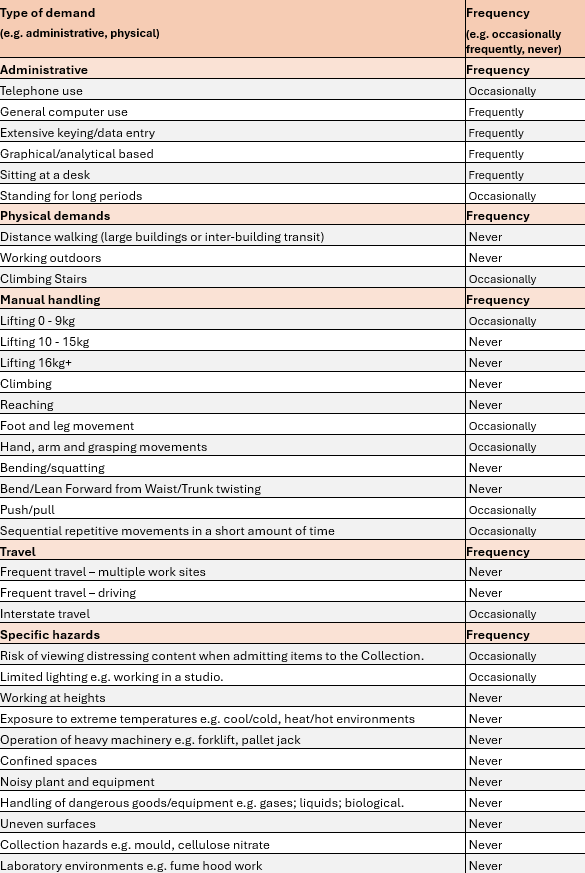
Work Environment Description
The following work environment description outlines the inherent requirements of the role and indicates how frequently each of these requirements would need to be performed. Please note that the National Film and Sound Archive is committed to providing reasonable adjustments and ensuring all individuals have equal opportunities in the workplace.
How to Apply
When applying via our online e-recruitment system, please address the details in the ‘Key Responsibilities’ and ‘Selection Criteria’ by outlining in 1,000 words or less, how your skills and relevant experience demonstrate that you would be our ideal candidate. Your current resume is also to be included in your application.
In addition to an application and your resume, the assessment process for this position may also include an interview and referee reports.
We welcome and encourage applications from people with disability, the LGBTIQ+ communities, from Aboriginal and/or Torres Strait Islander people, and people from culturally and linguistically diverse backgrounds.
Eligibility
To be eligible for this position you must:
Be an Australian Citizen.
Satisfactorily complete an Australian Federal Police National Police Check.
Obtain and maintain an Australian Government Baseline Security Clearance.
Obtain and maintain a Working with Vulnerable People registration.
What we offer you
We provide a diverse, inclusive, and supportive work environment with access to:
Great training and development opportunities.
Generous leave and flexible working arrangements.
Our Employee Assistance Program (EAP – a free counselling service for you and your family).
A competitive salary, plus 15.4% superannuation.
Rewards and recognition initiatives.
RecruitAbility
RecruitAbility applies to this vacancy. Under the RecruitAbility scheme you will be invited to participate in further assessment activity for the vacancy if you choose to apply under the scheme; declare you have a disability; and meet the minimum requirements for the job. For more information see: RecruitAbility | Australian Public Service Commission (https://apsc.gov.au)
Contact Officer
Marcus Hayman | Digital Preservation Deliver Manager
E: marcus.hayman@nfsa.gov.au
Ph: 02 6248 2220